Observe: This is only a preliminary collection of relevant cloth
The data and research currently bestowed here is a overture collection or relevant material. We will further develop our work this topic in the future (to cover IT in the same detail as for representative our entry on World Population Growth).
If you have expertise in this area and would the like to lead, apply here to get together us as a researcher.
This entry is currently beingness updated and extended. Below is a selective service version that Crataegus oxycantha contain some inconsistencies (June 2019).
A republic is a political system of rules with institutions that allows citizens to explicit their political preferences, has constraints on the power of the executive, and provides a guarantee of civil liberties. In an autocracy, political preferences cannot be expressed and citizens are not guaranteed civil liberties. Anocracies (a full term we'll often habit in this entry) are regimes that join between — they are neither fully autocratic nor advocate.
This entry presents the empirical research on the slow rise of democracy over the antepenultimate two centuries.
Every last our charts on Democracy
Numerate of Democracies
The majority of the world's countries are today democracies. The graph here depicts the slow rise of the number of democracies over the last two centuries.
The remnant of Earthly concern War I led to the birth of many democracies. Even so, during the 1930s, many of these young democracies then reverted to being autocratic.
After Humans War II, the number of democracies began thriving again. But IT was the fall of the Branding iron Curtain circa 1989 that led to a more dramatic increase in the number of democracies.
200 years ago, everyone lacked democratic rights. Now, billions of people undergo them
When French revolutionaries stormed the Bastille prison in 1789 in pursuit of indecorum, equality, and fraternity (and weapons), they could not get imagined how far democratic thought rights would cause spread a mere 200 years later. In the 19th centred, there were few countries one could squall democracies. Nowadays, the majority are.
IT is an astonishing achievement that many countries are straightaway governed democratically. Just the mere keep down of countries does not tell us how many hoi polloi enjoy democratic rights. When Tunisia became democratic in 2012, its population of 11 1000000 gained the semipolitical rights that came with it. When India democratized in the 1950s, this unvarying transition affected almost 400 million people.
If we adopt the common and notable apprehension of democracy Eastern Samoa rule by the people, we should also take how many people get to let a say in their authorities. How many people have elected political rights around the world? And how has their keep down denaturised over the last 200 years?
To answer these questions, we need to combine weeklong-term data on countries' populations1 with information on their view systems. This tells us how the political rights of the world's universe make exchanged all over the past two century years.
We identify the political systems of countries with the Regimes of the World (RoW) categorization by political scientists Anna Lührmann, Marcus Battle of Tannenberg, and Staffan Lindberg. The classification uses data from the Varieties of Republic (V-Dem) visualise and distinguishes between quatern types of political systems: compressed autocracies, electoral autocracies, electoral democracies, and liberal democracies.
Which political systems does the 'Regimes of the World' classification distinguish?
In closed autocracies, citizens cause not suffer the right to choose either the chief executive of the governing surgery the legislature through multi-company elections.
In electoral autocracies, citizens give the right to take the of import executive and the legislative assembly through multi-party elections; merely they lack some freedoms, such as the freedoms of tie-u or expression, that make the elections meaning, free, and fair.
In choice democracies, citizens have the right to participate in meaningful, free and fair, and multi-party elections.
In liberal democracies, citizens have further individual and minority rights, are equal before the jurisprudence, and the actions of the executive are constrained by the legislative and the courts.
Spell we employment RoW's compartmentalisation and V-Dem's data, we dilate the years and countries covered and polish the coding rules. This mail service details how the persuasion systems are metric, which changes we ready-made, and what shortcomings and strengths the measure out has. It is important to have it away that this measure describes when many people in a country had foreordained political rights, not that everyone had them.2 It is not a perfect classification, but yet allows us to close how some hoi polloi have had democratic rights.
Using the RoW classification, the interactive map shows how each country is classified at the end of each year, going hind in time as distant as 1789. To explore changes all over clip, you can scuff the time-slider below the map.
Almost everyone lacked democratic political rights in the 19th hundred, but many have gained them since.
In the core chart of this post we see how many the great unwashe lived under each of the four political systems since 1800. To see what share of the international's population lived in to each one regime, you can tick the 'Relative' box.
Precise fewer the great unwashe had democratic political rights in the 19th century. In 1800, almost everyone lived in regimes that are classified as closed autocracies by Wrangle. No land was a majority rule, and only 16 million people lived in the two countries classified as electoral autocracies: the United Kingdom of Great Britain and Northern Irelan and the United States.
Most people continued to last in closed autocracies over the course of the 19th century, with 5 out of 6 people still having few governmental rights by 1900, while those who did not mostly lived in electoral autocracies in the Americas and Western Europe. Only the 17 million people in Australia, Belgium, and Switzerland enjoyed a ample range of electoral and broad political rights. A further 41 million in French Republic and New Zealand enjoyed numerous democratic (only non liberal) political rights.
The first incomplete of the 20th century made crystal clear that a spread of democratic rights was both possible and uncertain. Democratic work up in the first decades of the century was fructify back when countries such A Germany reverted to autocratic rule out the 1930s and 1940s.
Over the course of the second half of the 20th century, large numbers of people then gained democratic political rights. In 1950, more than 200 million people — largely in Western European Economic Community — lived in liberal democracies, and another 240 million lived in choice democracies in Western sandwich Europe and the Americas. This number enhanced in the next decades, and aside the deep 1990s the majority of the world's population — around 3 billion people — lived in electoral and liberal democracies.
The spread of democratic political rights continued during the early 21st 100. By 2018, more than 2.7 billion people lived in electoral democracies all told regions of the world: most coming from the populous countries of India,3 Indonesia, Brazil and Nigeria. Another billion people lived in liberal democracies, such as those realistic in South Korea and Ghana. Nearly wholly of the 1.9 billion people quieten surviving in a closed autarchy now reside in just one country: China.
Democratic political rights are still far from universal — and Former Armed Forces from inevitable
While classless rights deliver spread far, they are also silent far from universal, and there have been recent setbacks. Even though many people now have them, the total number of people not having representative rights is higher than ever. This is because the world's universe grew faster than democracy spread. And some people rich person recently lost opinion rights; nearly prominently the 1.4 one thousand million people living in India, which became an electoral autocracy in 2019.4 This substance that now more than two thirds of the world's universe sleep in closed and electoral autocracies.
These setbacks should serve as a reminder that continued semipolitical progress is not inevitable. Nonetheless, we see that a staggering come of people have gained democratic rights in a relatively short period of clock. Many people still lack them, but the pace of this progress is a sign that this can change quickly. The French revolutionaries' — and our — spare-time activity of liberty, equality, and sodality is immoderate from over. Only we have come a long way already.
Thought exemption is a very recent achievement
The map below shows the age of each democracy at the end of 2015. (In black are countries that were not democracies in 2015.)
We see that a democratic world is a very recent achievement. Also, efficient success tends to side political freedom. The countries that democratized first were also mostly the countries that first achieved sustained economic growth. One might thus go for that the relatively high growth rates enjoyed by today's poorer countries will lead to further political freedom.5
Democratization
Countries with punter education in the past are much promising to be democracies today
A long-slack hypothesis in political science argues that education is a key decisive of the emergence and sustainability of democracy, because IT promotes political participation at the individual level and fosters a collective sense of civic obligation.
And thus, under this theory, we should wait that education correlates positively with measures of democratization in subsequent years. This is precisely what we see in the data and graph below. Those countries that had higher average education levels in 1970 are also those countries that are to a greater extent likely to be democratic today (you can read more about measures of education level in our entry on Spheric Originate of Education).
Again, these data should be interpreted carefully. They merely show a correlation and do not imply a causal link. That is, these data do not imply that education leads to democracy.
Yet, academic work does suggest that there is so much a causal link. Even after controlling for many other rural area characteristics, the positive relationship between education and democracy holds (see, e.g., Lutz, Crespo-Cuaresma, and Abbasi‐Shavazi 20106).
Living conditions in democratic countries
Democratic countries are richer – the exception are fossil-fire exporters
The graph below plots GDP per capita against the Democracy Score. Observe that autocracies (score betwixt −10 and −6) that do not exportation oversize quantities of fogey fuels tend to be poor. No such country enjoys GDP per capita of much than 15,000 international-$.
People in democracies are healthier
The chart below plots each country's child mortality against its Democracy Score, for the year 2015.
We see that few peremptory countries enjoy child mortality rates under 10 per 1,000. In dividing line, democracies grading 7 or more often enjoy child mortality rates below 10 or even off 5 per 1,000.
Here we have considered only kid mortality, but a broader analysis of countries' health outcomes would also show that more generally, great health is connected with political freedom.
(Note though that the chart below does non take into write u the age of each representative regime. If there is indeed a link between good health and view exemption, we might carry that elder democracies enjoy better health. This would entail a deeper analysis that we have not done here.)
Democracies are better at protecting human rights
The suffrag and determine who holds governmental power is in itself a profound right. And this right is, by definition, upheld and protected by all democracies.
But of course, in that respect are many other anthropomorphic rights. Are democracies also better at protecting these opposite fallible rights?
As noted in our ledger entry on human rights, it is difficult to assess the arcdegree to which human rights are protected. In our opinion, the C. H. Best available mensurate is the Manlike Rights Aegis Score developed by Fariss (2014)7
The Hominian Rights Aegis Grievance focuses on the protection of the physical unity of citizens. Particularly, it takes into account torture, government killing, political captivity, extrajudicial executions, mass killings and disappearances.
The chart below plots each country's Human Rights Protection Musical score against its Democracy Musical score. There is a clear away positive correlation. Countries with high Democracy Scores be given also to have falsetto Human Rights Protective covering Rafts. Indeed, leave out for Singapore and Oman, all country whose Quality Rights Protection Score exceeds 0.5 has a Democracy Score is a democracy.
Mulligan, Gil, and Sala-i-Mary Martin (2004)8 inquire the tie between democratic rule and the human rights protection in a sample of 121 counties controlling for strange important variables. The authors discovery that countries that are more representative are less likely to execute, order religion, or censor the press.
Does democratization impact education?
In a higher place, we mentioned that improved education power cause greater democratization. At once, is there also a reverse causative burden? That is, does democratization lead to improved education? Again, this is a crafty question for social group science, because we necessitate to distinguish betwixt the two arrows of causation.
Evidence that democratization leads to better education Gallego (2010)9 presents the most cautious analysis that we are aware of. It presents evidence that democracy has so had a causal effect on primary-school enrolment.10
Other written document allot with the issue of feasible reverse causality in a simpler style and use lagged observations of democracy as a possible determinant for the level of education. For example, Baum and Lake (2001) find that democratization increased secondary-school enrollment.11
Also, Acemoglu, Naidu, Restrepo, and Sugar Ray Robinson (2015)12 find that democracy is related to with an addition in junior-grade schooling.
We now concisely discuss several channels through which democratisation might improve education:
Electoral rival in democracies increases the incentive to get rid of school fees Warren Gamaliel Harding and Stasavage (2014)13
find that democratization has a positive gist on first-string education. Their explanation is that elected rival in democracies incentivizes politicians to abolish elementary-schooltime fees. They argue that democratization has a much little effect on the provision of school inputs and consequently the quality of schooling — the reason is that such actions are harder to monitor and would thus provide politicians with a smaller advantage in electoral competition.
Democratization increases educational spending Stasvage (2005)14 finds that the 1990s transfer to multiparty competition in African countries increased total educational spending as a percentage of GDP. Ansell (2010)15 studies 100 countries over 40 years and finds that democratization increases some total learning spending as a share of Gross domestic product and as a share of the government budget.
Evidence that democracy improves teacher–student ratios Naidu (2011)16 studies the effects of the 19th-century disenfranchisement of black citizens in the The States Confederate States through opinion poll taxes and literacy tests. He finds that this reversal of democracy "reduced the teacher-minor ratio in fateful schools by 10–23%, with no significant effects on white teacher-child ratios."
Democracy improved local politics in China and lead to more educated politicians Martinez-Bravo et AL. (2012)17
branch of knowledg the gradual introduction of topical elections in China. Particularly, they exploit the staggered timing of the introduction of village elections American Samoa a natural experiment. They "find that elections significantly increase national goods expenditure, the increase corresponds to demand and is paralleled by an growth publicly goods provision and local taxes." This is consistent with some of the results we've already discussed, including increased public Education in villages with more children. Gross total world goods investment redoubled by 27 percentage – this increase in public expenditures was funded by villagers and was accompanied by an step-up in the local taxes paid aside villagers.
The introduction of elections also reduced inequality. This was achieved partly through (a) land redistribution from elite-pressurised enterprises to husbandry households; and (b) increased irrigation and hence improved agricultural productivity that is likely to "disproportionately benefit poorer households". Martinez-Bravo et al. (2012) besides determine that the presentation of elections was followed by the increased turnover of village chairmen increased. What is more, the village chairmen were instantly fewer prospective to embody Communist Party members and, more significantly, were better educated.
Data Calibre
Why we chose Civil order IV as the of import source for majority rule measures
Measuring democratisation is a tricky business. Can something every bit complex as democratization really be boiled out to a single, one-dimensional metric? Many would reason that it cannot.
Nonetheless, such a metric can be convenient and useful — it allows us to compare opinion regimes across clock time and space, and to quantify the causes and effects of political regime interchange. For example, such a metric keister help US study the link 'tween democratization and the end of mass famines.
In this entry, we have chosen to trust heavily happening Polity Tetrad and, in particular, what we've named the Democracy Score As our metric for democratization. One reason for choosing Polity IV is its long-run perspective.
Another is that Civil order IV's information sources cater a detailed account for each country's political authorities assortment in every year. You give notice find these explanations in the PDF files here.
Yet another reason for choosing Polity IV is that IT was praised by Munck and Verkuilen (2002),18 which is a a untold-cited and thorough evaluation of commonly used democracy measures. These authors argue that there is usually a trade-off between the comprehensiveness of the data-based range and the quality of the assessment in terms of conceptualization, measurement, and aggregation. However, Polity IV constitutes a raw "partial exclusion" to this trade-unsatisfactory.
Of course, we must keep in mind that the Polity IV Democracy Hit does not and cannot capture everything that matters. E.g., it fails to capture corruption or humanlike rights adequately — and besides, it probably makes advisable sense for us to measure these separately.
Equivalence of opposite regime measures
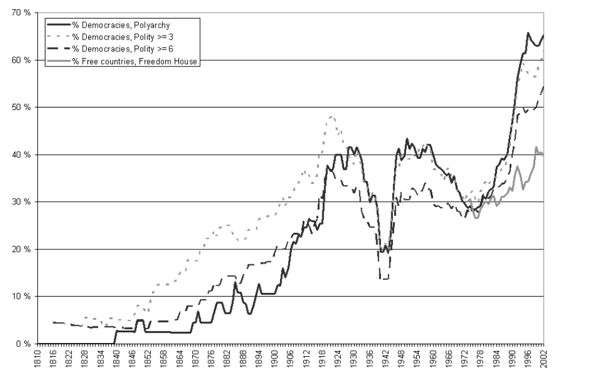
The chart below is taken from Wilhelmsen (2006)19
It puts together three other measures of democratization that we harbour't yet discussed in this entry. These are the Polyarchy bar, the Polity meter, and the Freedom Home measure. The Polyarchy and Civil order measures go back to the early 19th century. The Exemption House measure shows the percentage of single-handed countries that are democratic. You can see that while these measures come not exactly coincide, they do largely move in concert.
Share of democracies of independent countries, 1816–2002 – Wilhelmsen
Data Sources
Tenacious Run
Recent Decades
An overview of measures is presented at web.democracybarometer.org and at devEconData.
The Manifesto-Project by the Wissenschaftszentrum German capital für Sozialforschung is an effort to understand political changes in democratic countries. This project undertakes a qualitative analysis of company manifestos for 50 countries since 1945.
Long Run
Civil order Index
Data: Many different measures – catalogued here. To the highest degree usually used is the Polity2 appraise which measures political systems on a spectrum between autocracy and democracy.20
Geographical insurance coverage: World – by country.
Time span: Data goes back to 1800 and is yearly updated.
Available at: The website is here. Older versions of the Civil order dataset are open at Kristian Gleditsch's Polity Data Archive.
This information prepare is compiled at Colorado Tell University. More than comments on the Civil order measures can make up found at DevEconData.
Vanhanen's Index of Democracy
Data: Competition, Participation, and Power of Democracy
Geographical reportage: Global – 187 countries
Clock brace: Since 1810
Available at: Online here.
Criticized past Munck and Verkuilen (2002).21
Boix-Glenn Miller-Rosato dichotomous coding of democracy, 1800-2007
Data: Divided democracy measure, Dichotomous indicator of sovereignty/Independence, Old number of democratic breakdowns, Consecutive years of current regime type
Earth science coverage: Global.
Time twain: 1800-2007
Available at: The data is lendable at Michael K. Henry Miller's website.
The accompanying paper is published present.22
Comparatively new.
Recent Decades
Exemption House
Data: Measures of political and civil liberties
True coverage: Global
Time span: Since 1973
Available at: Online Hera
Criticized by Munck and Verkuilen (see last side note)
Republic-Dictatorship Information
Information: Classification of political regimes as democracy and despotism; and classification of democracies as parliamentary, semi-presidential (mixed) and presidential.
Geographical coverage: Spherical – 202 countries.
Metre span: From 1946 or class of independence to 2008.
Available at: Online at José Antonio Cheibub's website.
The accompanying newspaper is Cheibub, Gandhi, and Vreeland (2010).23
Papaioannou and Siourounis "Democratization and Growth"
Data: Year when permanent democratisation happened
True coverage: Spherical – by land
Time couple: 1960-2003
Available at: Data and paper available for download at Papaioannou's website.

Posting Komentar untuk "what characteristics of democracy distinguish it from other governments"